Design
Jan 09, 2026
Anatomy of a Technical Rebrand: When and Why to Change Visual Direction
"Does our current visual identity still represent us, or is it holding us back?"
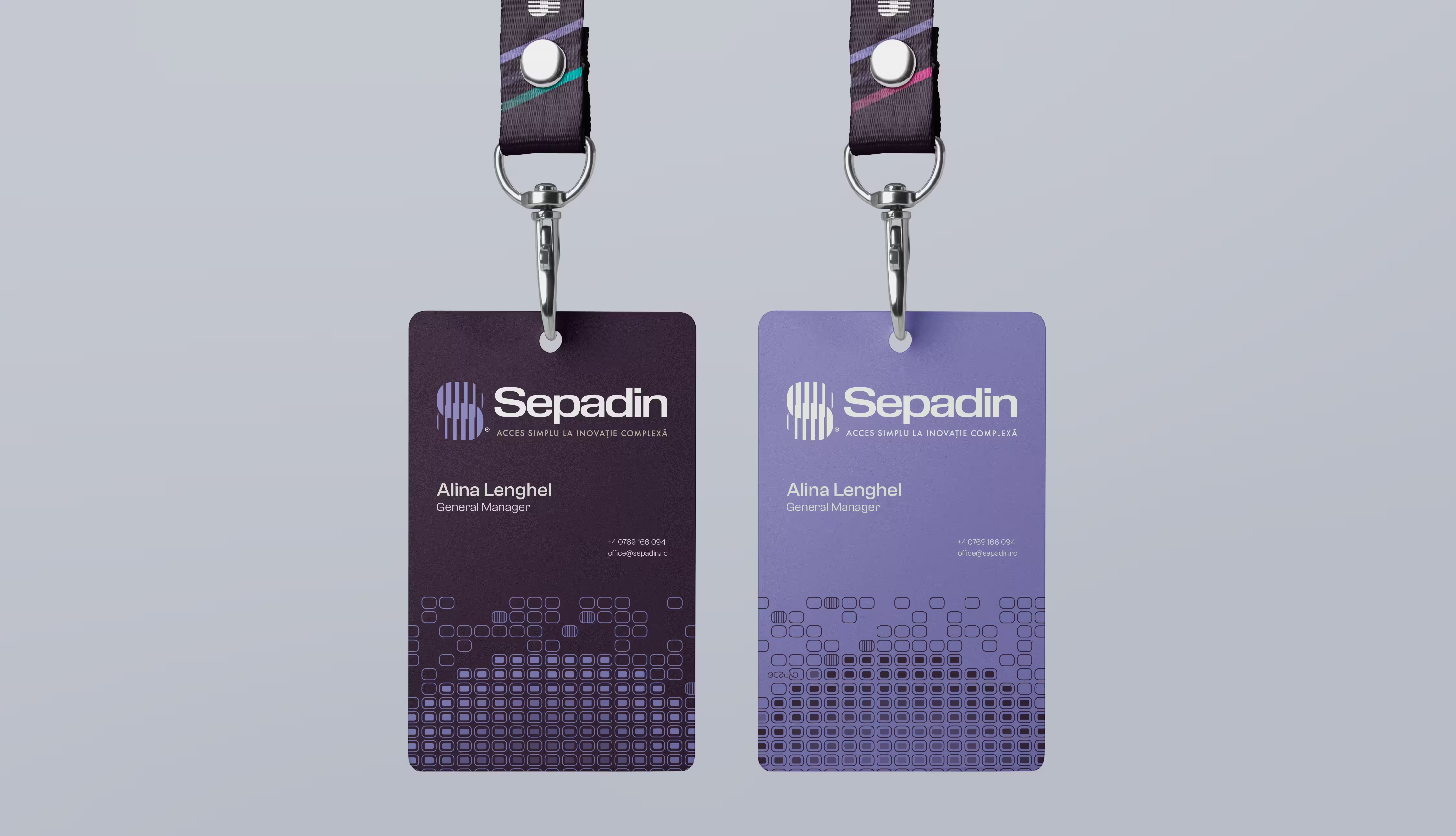
In sectors where precision is the currency, from SaaS development to laboratory equipment manufacturing or medical clinic management, operational excellence often outpaces brand maturity.
Companies scale, technology evolves, but the visual identity stays frozen at the "startup" stage or in an outdated utilitarian aesthetic.
A technical rebrand is not a cosmetic refresh. It is the realignment of visual infrastructure with the business's current reality, transforming design from a cost centre into a proof of competence.
Symptoms of a brand that has fallen behind
How do you know you need a repositioning? The clearest signal is the gap between the quality of your solution and how it is perceived.
Medical / Clinics: Visual identity feels "cold" or incoherent, generating anxiety rather than trust and safety.
Laboratory Equipment: Device interfaces or technical manuals are hard to navigate, suggesting imprecise technology.
Software / IT: The image no longer reflects the security level or complexity of the current architecture.
If your sales team feels the need to apologise for how presentation materials look in front of a corporate client or hospital director, you have an authority problem.
Visual audit: diagnosis before treatment
Any rigorous rebranding process in high-precision sectors starts with a visual audit. We are not evaluating whether the logo is "beautiful", but whether it is functional and trustworthy.
Information hierarchy: In medicine or labs, colour and typography play a critical role. Are visual alerts clear? Is text legible in low-light conditions?
Ecosystem consistency: The brand must work identically on an 8K screen, on medical device packaging, and on clinic signage.
Differentiation through rigour: In a market saturated with generic blues, how does your brand communicate "certified innovation" vs. competitors?
The pillars of a modern visual identity in critical sectors
A modern visual identity in technical domains is built on three pillars adapted to that complexity:
Foundational strategy
Shifting from "what we sell" to "what we guarantee". For a clinic, that is empathy; for a sensor manufacturer, it is micrometre accuracy.
The Design System (The Core)
Building modular elements. We don't just draw a logo, we build a set of rules that allow rapid scaling of new divisions or product lines without diluting the parent brand's authority.
Handoff and implementation
Integrating the new identity into existing workflows: software UI, hospital signage, laboratory reagent packaging.
Diagnostic checklist: is it time for a change?
Run your organisation through this stress test. If you tick more than 3 points, your current visual direction is slowing your growth:
Our brand looks visibly more dated than our global competitors.
New clients question the modernity of our technology because of how the interface or website looks.
We struggle to apply our visual identity to new formats (small screens, printed equipment).
We have acquired or launched new divisions that no longer fit under the current brand "umbrella".
Our image no longer attracts top talent, doctors, researchers, or elite engineers.
Design as a trust multiplier
In technical and medical sectors, perception is inseparable from performance. A fragmented brand suggests a product or service with gaps.
By approaching a strategic rebrand, you transform design from an aesthetic cost into an asset that accelerates trust with patients, partners and investors.

Alina Lenghel, Managing Director @ Sepadin
"He is extremely professional, immediately understood who we are and what we were looking for, and that is clearly reflected in all the materials he subsequently created for us: logo, website, digital materials, print and more."

