Design
May 18, 2026
Maternitatea Giulești: Trust Rebuilt Through Design
The first public hospital website in Romania designed around the patient experience.
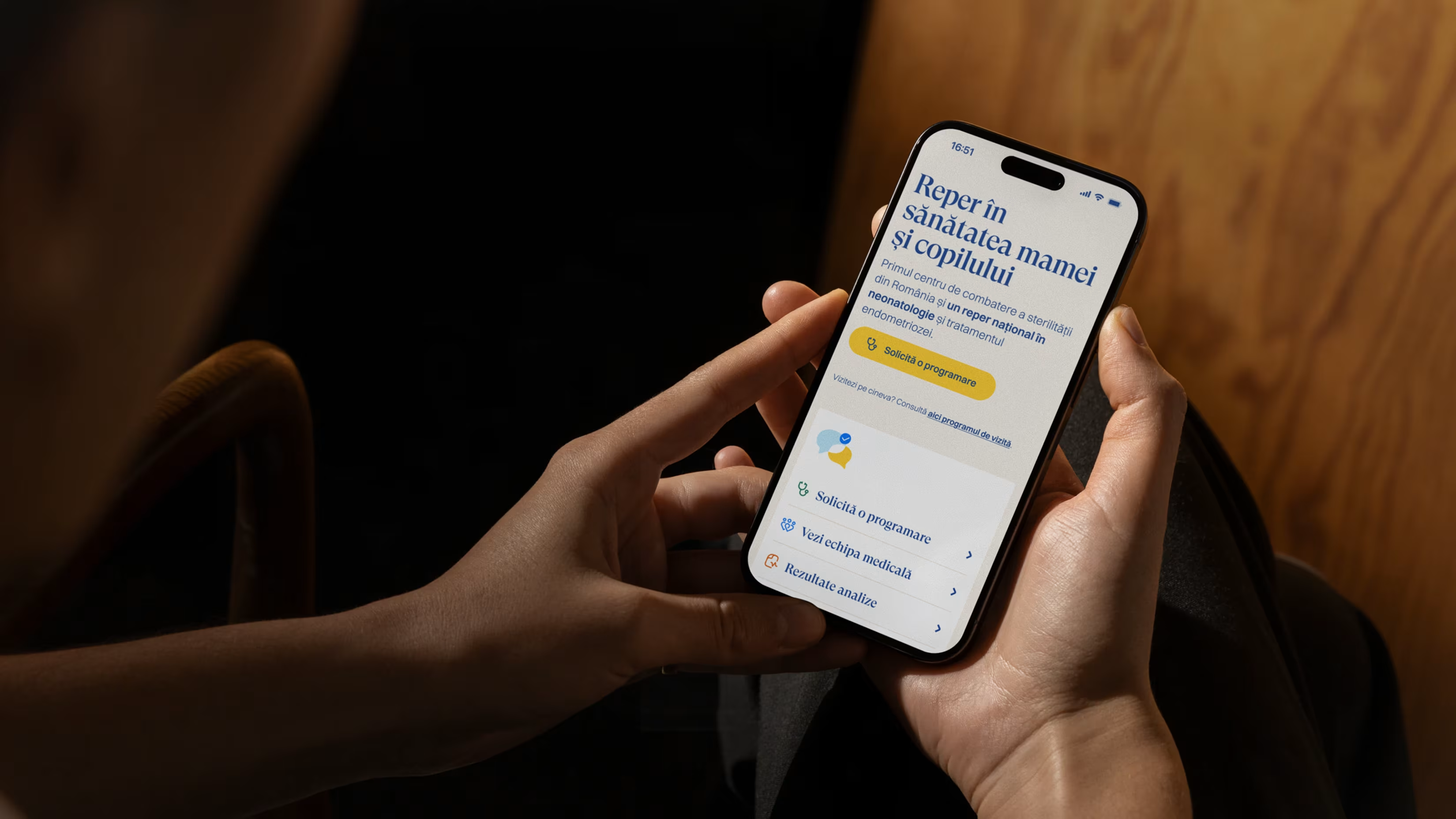
There is a simple test you can run at any time on a Romanian public institution's website: you go in, look for something concrete, a schedule, a phone number, a procedure, and measure how long it takes to find it. Or until you give up.
Most public hospital sites fail this test in under a minute. Not out of ill will, but because of a perspective error that has perpetuated for decades: these sites are built from the inside out. They reflect the organisation's internal structure, not the journey of a person arriving with a real need. Menus follow the org chart. Language follows bureaucracy. Design, where it exists, follows a template won at tender.
The redesign of Maternitatea Giulești, the Clinical Hospital of Obstetrics and Gynaecology "Prof. Dr. Panait Sârbu", started from a different question. Not "how do we organise the information we have?" but "what is the person opening this website actually looking for?"
Context: a hospital with a real history
Maternitatea Giulești is not just any hospital. It is the place where entire generations of Romanians were born, a centre with over a century of tradition, Romania's first fertility treatment centre, and a national landmark in neonatology. It also carries the scars of history, the 2010 fire is part of the country's collective memory.
This is precisely why the project was more complex than it might first appear. It was not about building a brand from scratch, but about finding the right visual and informational language for an institution that carries real weight in the public consciousness. A language that would not lie, would not gloss over reality, but would not get lost in old institutional reflexes either.
The starting point was research. Maternity and public hospital websites from Romania and abroad were analysed. Patient testimonials in online spaces were examined, not surface-level reviews, but the long, worried, sometimes angry accounts in which people describe what they could not find, what they did not understand, what left them alone.
My wife was admitted and I didn't know when I could come, how long I could stay, what I could bring. I called six times before reaching anyone. Visiting hours were posted on a paper stuck to the door, which I couldn't see from the outside anyway. I came twice for nothing.
Mihai, 35, family member, wife admitted
I was afraid to go public because I didn't know how it worked, who my doctor was, whether the same doctor would assist at birth, whether I could ask for anything or not. I went to the maternity website and found a page with PDFs from 2018 and a fax number. I chose private even though I couldn't easily afford it, simply because I didn't understand how the public system worked.
Oana, 29, pregnant, first prenatal appointment
With my first child I spent 3 days not knowing when I'd be discharged, what documents I needed, how to register the baby. I learned everything from other mothers in the ward. For the second I chose the same hospital because the doctor was good, but the same problem, information didn't exist anywhere. I went to the website before giving birth and left more confused than I arrived.
Cristina, 31, mother of her second child
25% of women who give birth each year in Romania have their first contact with a medical professional only during labour. Not from negligence, from lack of accessible information, from fear, from distrust. A system that communicates clearly can change this.
Ana Maița, president of Mame pentru Mame Association, quoted in PressOn
The premises that shaped the design
1. The central tension
Maternitatea Giulești lives within an authentic tension: public vs. private, old vs. modern, vulnerability vs. strength. The site must be honest about this duality, not cosmetically mask it.
Premise #1
Authenticity is the brand. Giulești is not competing with Regina Maria. It is competing with the lack of trust in the public system. The design must rebuild trust, not imitate private luxury.
2. The real user
A mother searching for a maternity hospital is not browsing calmly from an armchair. She is pregnant, anxious, comparing options, looking for signs of safety. Her partner is searching on his phone at 11pm. The grandmother doesn't know how to scroll.
Premise #2
Design is an act of radical empathy. Every typographic decision, every visual hierarchy, every CTA must answer the question: "What does this person feel at this moment?"
This translates into: extremely clear navigation, urgent information at the surface (admissions, birth), warm but precise language.
3. Information architecture
Premise #3
A public hospital website is infrastructure. People arrive with concrete needs. This means the site's architecture is built from real user tasks, in order of frequency:
How do I get admitted / give birth here?
Which services are free vs. paid?
How do I contact a doctor?
Beautiful but confusing menus are a major barrier on a hospital website.
4. The design system
Premise #4
I design a system, not a page. The hospital will grow, new departments will appear, there will be a need for crisis communication, campaigns, printed materials. The visual system must be robust enough and simple enough to be used by people who are not designers.
What came out of it
The current Maternitatea Giulești website is, in the digital landscape of Romanian public institutions, an anomaly. Not in a negative sense, in the sense that it resembles nothing else that exists around it.
The maternity bag page is a concrete example of the logic that governed the entire project. It is a page built for a woman preparing for an experience she has never been prepared for before. Information is organised into clear categories, the language is human, the tone is that of someone who understands you don't know, and that's okay. No unnecessary medical jargon. No PDF to download in Courier font from 2014.
The medical team is presented through a filtering system that starts from the visitor's logic, not the hospital org chart. You can filter by department, by specialty, you can see a doctor as a person. Fifty-four doctors from an Excel spreadsheet became human, searchable, navigable profiles.
The visual identity rejects both the commercial superficiality of private clinics and the cold austerity of government websites. Typography combines an authoritative serif, credibility, an institution with tradition, with a highly legible sans-serif for body text. The colour palette goes beyond the generic medical blue you find everywhere. Photography is documentary, warm, human.
The result, if the premises were respected, is a feeling that few visitors still associate with a public hospital website: that this place understands you. That it has nothing to hide. That the people working there are working for something.
Why this matters beyond one project
Romania has a problem with institutional digital. It is not a money problem, there are EU projects, there are funds, there are won and implemented tenders. It is a perspective problem.
Public digital projects are, very often, built to tick a compliance criterion. The site exists. It has pages. It has a contact button. The procurement file is complete. That the person arriving with an urgent need leaves more confused than they came, this does not appear in any performance indicator.
There is, however, a pragmatic argument for user-centred design in the public space, beyond its aesthetics: it works. A mother who understands how the system works before admission puts less pressure on medical staff during critical moments. A family member who finds visiting hours online does not block the phone line. A pregnant woman who gains trust in the public system online does not choose private out of desperation.
Where Romanian digital is heading, or should be
There are a few mindset shifts that could transform the way Romania builds digital products for people.
First: user research must become the norm, not the exception. Not formal surveys with large budgets, just the simple practice of talking to the people who use the product. Understanding what they look for, what they don't understand, where they give up. The Maternitatea Giulești design started from real stories. They were not hard to find, they were on forums, Facebook groups, in comments on hospital pages. They can be read and understood to build something better.
Second: language matters as much as the interface. Half the failure of Romanian public digital is not visual, it's textual. Bureaucratic phrasing, information structured by the sender's logic rather than the receiver's, a lack of empathy in every sentence. A button that reads "Submit elective hospitalisation request" instead of "Book my appointment" is not a detail, it is a barrier.
Third: systems are more valuable than pages. Romania tends to build digital through one-off projects: a new site, an app, a platform. Without thinking about what happens after launch, who updates it, how it grows, how it adapts. A well-designed design system, typography, palette, components, tone, costs once and saves ten times over.
Fourth, and perhaps most important: the standard must rise. Romania has designers, developers, UX specialists capable of building at a high level. We only need a context that demands it. As long as public tenders evaluate based on lowest price and a list of technical deliverables, rather than the quality of the user experience, the market will calibrate to the accepted minimum.
Maternitatea Giulești shows that things can be different. Not as a blessed exception, but as a proof of concept. A public hospital in Romania can have a website that is, simultaneously, honest about the institution's limitations and ambitious about the experience it offers the vulnerable person who opens it at 11pm, hands on their belly, looking for a sign that everything will be okay.

Just a few weeks after launch, the number of online bookings grew by over 600%. A website alone cannot repair the relationship between people and the public system. But it can remove friction, reduce anxiety, and make the first contact with the institution more human. Sometimes, that is enough to begin rebuilding trust.
Vali Tronaru, Brand & Product Designer

Daniela Anania, CEO @ eOrion
"Working with him was effortless, and communication was smooth and comfortable. What stood out the most was how collaboratively we developed ideas and how skillfully he refined and enhanced them, delivering a result far beyond what I initially envisioned."

